Thursday, July 30, 2009

True Joy Means Making a Difference

Joy.

The world needs more of it. You can provide it.

When I first got into fundraising, I thought it would be great helping people live better lives. The best part of my job, however, is witnessing the joy donors and volunteers experience when they shared their resources to help others.

I hear the sounds of joy every day at McWane Science Center. Sounds we wouldn’t hear if it weren’t for generous donors who provide exciting, fun, educational exhibits and programs.

If you have been a part of providing this joy for the 11 years that McWane has existed, thank you. We have depended on corporations, foundations, government entities and some individuals who have made major gifts. But Toto, we are not in Kansas anymore.

McWane is a thriving organization in terms of the experience, attendance and memberships. April and June of this year saw record attendance. Memberships are growing, yet there’s room to grow. Might I unabashedly say it’s a great deal if you come just twice a year?

Lots of folks don’t realize that McWane Science Center is a nonprofit. It costs us about twice as much to serve visitors as we charge. We want to remain affordable for everyone to enjoy the benefits of hands-on science education.

Science literacy is important. Our kids must grow up knowing how to solve problems with the environment, energy, technology, etc., McWane supports families and teachers in our mission “to change lives through science and wonder.”

True joy is watching another delight in something. Knowing a person is learning skills and that we are igniting a lifelong love of learning is icing on the cake. By donating to McWane Science Center, you can experience the joy of being a part of something really big - you can provide joy for thousands of kids.

From outside my office, I can hear hundreds of kids excited as they get off of school buses. In the lobby, I hear kids crying that they don’t want to leave. It’s in those moments that I know what we are doing is working. Kids love experiential learning. AND THEY NEED IT if there’s to be hope for our future.

We need your financial support more than ever. If you don’t have a membership, buy one. Tell others what a great value memberships to McWane are - give them as gifts. A donation of any size - $25 to thousands of dollars - will help our community. You can provide hope for the future. And when you do that, you can experience great joy.

l’ll step off of my soap box now.

Contributor Profile:
Linda H. Baker is the vice president of development and marketing for McWane Science Center and mother of three boys. After a tour in corporate communications and print media, she found her purpose for existing: to help people find true joy.

Friday, July 10, 2009

Birds of a Feather - Part 2

by James Lamb, Paleontologist


There are to date at least 21 different types of dinosaurs that are known to have had feathers. Even Velociraptor, a well-established dinosaur, appears to have had a feather coating, as a recently discovered specimen shows that it had the bumps on one of its forearm bones called “quill nodes” that indicate where feathers attach in modern birds. In fact, it appears very likely that all carnivorous dinosaurs (the group called theropod dinosaurs) had feathers, at least as juveniles. It also seems that the dromaeosaurs, the specific group of theropods that Deinonychus belongs to, are the closest relatives to birds. Many of the feathered dinosaur skeletons have the switchblade claw on their hind feet. Recently, there have been discoveries such as the “bristles” on the back on the small Triceratops relative Psittacosaurus, and just two months ago of what appear to be feathers on the heterodontosaurid dinosaur Tianyulong, that indicate that perhaps all dinosaurs had feathers, at least originally (although they may have been lost later by such groups as the hadrosaurs (duck-bills) which we know from skin impressions did not have feathers). This is because Psittacosaurus and Tianyulong are plant-eating dinosaurs that are not close relatives to theropods, and in particular heterodontosaurids are near the base of the dinosaur family tree.

So what did a dinosaur need with feathers?

The key question about the origins of flight in birds if dinosaurs are indeed their ancestors, is how did ground-dwelling animals become flying animals? Looking at the range of feather types in modern birds, Dr. Alan Brush has worked out the probable sequence of the evolution of feathers from a reptilian type scale. The problem is that the intermediate stages in feather evolution, say, halfway between a scale and a feather, are not capable of sustaining flight. That means that feathers were originally evolved for a purpose other than flight, a purpose for which intermediate grade feathers provided some useful function. It appears that the answer to this riddle is that feathers originally were for insulation. We now know from a variety of evidence that dinosaurs almost certainly had some form of warm-blooded metabolism, and the earliest dinosaurs were all small animals. Small warm-blooded animals lose body heat more rapidly than a large animal with the same metabolism. To prevent the loss of body heat, small warm-blooded animals need insulation. Dinosaurs had feathers for the same reason that mammals have hair – to stay warm. Indeed, birds and mammals are the only warm-blooded animals. Mammals inherited fur from their ancestors, birds inherited feathers from their ancestors. The intermediate stage of a feather may not work for flight, but it does work as insulation, at least better than a scale. Only later were they co-opted for use in flight. For many years though there hasn’t been a satisfying explanation for how theropod dinosaurs made the transition into the air. The final piece came a few years ago with the work of Dr. Ken Dial, and is known as WAIR, or wing-assisted-incline-running. I’ll give an example from personal experience how this works.

Some years back, while searching for dinosaurs, umm, fossil ones, in central Alabama, I was walking through a stretch of woods to get to a site, when I scared up a wild turkey in the underbrush. I’m not sure which of us was more surprised; turkeys generally rely on camouflage, and will hide quietly in a bush and let you walk right past them. Evidently, this one decided at the last instant the camouflage wasn’t working because the turkey exploded out of a bush within arms reach in a cloud of leaves and feathers and with a noise equivalent to what I thought of at the time as a charging rhino crashing through the underbrush. The turkey sprinted across the clearing, heading towards a large cedar tree. And then it did the oddest thing – it waited until it was right at the tree and then flew vertically up it, it’s chest just inches away from the trunk. Heart pounding, still checking to see if my pants were still dry recovering from the initial surprise, the whole thing having taken less than 2 seconds, I began to wonder why it had waited until the last instant to fly up the tree instead of taking off and flying in a shallower trajectory into the tree. What WAIR proves is that in fact the turkey did not fly into the tree at all, it RAN into the tree – vertically up the trunk.

Dial has spent many hours filming birds running up the trunks of trees. He has shown that a bird can run up a tree quicker from a short distance than it can fly into the tree. In fact, this happens so quickly that it can only be seen in high-speed video footage, which is why the turkey appeared to me to have flown up the tree. Further, birds only a day or two old exhibit this behavior, and also sometimes run up inclined surfaces and use it as a launching point to glide away from danger long before their wings are developed enough for flight. He has documented that birds can run up completely vertical surfaces in this manner, flapping the wings both as a propulsive assist and to help keep the feet pressed against the tree. It also turns out that they move their arms/wings in exactly the same manner that they do during active flight. This is almost certainly the origin of flight in dinosaurs – small dinosaurs with feathers evolved for insulation modifying a predator-escape behavior for a new purpose.

Next week: Birds of a Feather Part 3

Contributor Profile:
James Lamb is a native Birminghamster with a nearly life-long interest in fossils. He collected his first fossil when he was 5 years old. Friends and family members assure him he has not matured much since then. James is curator of paleontology at McWane Science Center, and would like to one day see the absolute treasure trove of Alabama's fossil heritage revealed to the public. When not at work he wishes he were in the field digging up fossils. At home he enjoys reading, jogging, woodworking, and carving. He has been informed that he is in the habit of telling atrocious puns, but this comes as a surprise to him. James describes himself as a "science nerd".

Friday, July 3, 2009

Birds of a Feather - Part 1

by James Lamb, Paleontologist

The pair of fighting dinosaurs tumbled across the sidewalk in front of me, bringing me to an abrupt halt. Screeching, flipping tail over talon, grasping at each other with their sharp, three-toed hind feet and stabbing at each other with their mouths, they didn’t even pause when they rolled over a vertical drop twice their own body length. Finally they separated, each lying on its back, and continued to screech ferociously at one another. It was just in time too, as the drop off the curb had brought them perilously close to the street. Well, at least I didn’t have to jump in and break them up before they got in traffic. Then, as the two White-throated sparrows flew off to nurse their wounds in relative safety, I couldn’t help but think how glad I was that these little feathered dinosaurs were so tiny compared to their now extinct cousins. Imagine if they were the size of Deinonychus, the villains of Jurassic Park (incorrectly called Velociraptor in the movie) - no one would ever go outside.

At this point you are perhaps wondering if you read the previous paragraph correctly. Did I really mean that birds are little feathered dinosaurs? Well, yes. As amazing as it seems, birds are essentially the only group of dinosaurs to survive the global catastrophe 65 million years ago when something like 65% of all life on Earth became extinct. Dinosaurs had been the most successful terrestrial vertebrates ever; a group that dominated terrestrial ecosystems for 150 million years. And, except for birds, they’re all gone. But – dinosaurs? Really? Let me start the story at the beginning, always a good place to start.

The oldest known bird, Archaeopteryx, lived about 145-150 million years ago. The first specimen was discovered in 1861 and right from the beginning stirred controversy because of its mixture of avian (bird-like) features such as feathers, and more “reptile-like” features such as teeth and clawed, three-fingered hands. There were scientists even then who thought that the best match for bird ancestors were the dinosaurs. At the time though, there was only the one Archaeopteryx specimen and no particularly good match amongst dinosaurs for many features of the skeleton then known only in birds. The ancestry of birds remained in a sort of limbo for the next 100 years, with various groups of reptiles favored by different paleontologists. All that changed in 1969 with the publication of the formal description of Deinonychus. Deinonychus broke the mold of the old stereotype that dinosaurs were slow, lumbering, dim-witted animals with “extinction” stamped on their bony foreheads. Not only does the skeleton imply speed and grace, they had a sickle-shaped claw on the second toe of each hind foot that could be rotated through 180 degrees. The claw was held off the ground when running and then rotated into slashing/killing position once the prey had been captured. One of my college professors used to refer to Deinonychus and its kin as “Bobcats with a switchblade on each foot”. Perhaps equally as interesting were the skeletal similarities to birds.

One of the things that is unique about birds is the special arrangement of bones in the wrist that allows them to fold their hand, that is, the wing, which is mostly formed from an elongated hand, up against their body, and rotate the hand/wing properly to achieve the flight stroke. Deinonychus had this same feature. Deinonychus also possessed what until then was a uniquely bird characteristic called the “triosseal canal”, a trough formed by three bones in the shoulder region that allows the flight muscles that attach to the sternum, the breastbone, to loop over the shoulder like a pulley and power the recovery stroke of the wing during flight. Deinonychus appears to have evolved these features to use its long and mobile arms in capturing prey. Finding these features in Deinonychus started a flurry of renewed interest in the dinosaur/bird connection, and over the next couple of decades, as new dinosaur discoveries were made, and more Archaeopteryx and other early birds were found, paleontologists documented over 100 skeletal features shared uniquely in the animal world by only dinosaurs and birds.

Then came the fossils from dinosaur-aged lake deposits in China. The chances of any particular organism being preserved in the rock record are not good. The main reason for this is that most animals don’t die in an environment where they will be quickly covered up by rock-forming sediments such as sand or clay. The ancient freshwater lake deposits in China are an exception. Animals were buried quickly in fine-grained sediment that not only preserved the skeleton in near life position, but also so effectively sealed the fossil from the air that traces of soft tissue are often preserved. Many of the fossils coming from these deposits are of feathered dinosaurs. That is, traces of feathers, in some cases surrounding the skeleton in a sort of halo are preserved as a carbonaceous film. Not only did scanning electron microscope images show that these have the highly distinctive structure of modern bird feathers, they also have the same chemical signature as feathers. Feathers are made from a tough structural protein called keratin. Hair, fingernails and claws are other examples of biological structures made from keratin. However in the animal world only feathers are made solely of a single type of keratin, called beta-keratin.

Next week: Birds of a Feather Part 2

Contributor Profile:
James Lamb is a native Birminghamster with a nearly life-long interest in fossils. He collected his first fossil when he was 5 years old. Friends and family members assure him he has not matured much since then. James is curator of paleontology at McWane Science Center, and would like to one day see the absolute treasure trove of Alabama's fossil heritage revealed to the public. When not at work he wishes he were in the field digging up fossils. At home he enjoys reading, jogging, woodworking, and carving. He has been informed that he is in the habit of telling atrocious puns, but this comes as a surprise to him. James describes himself as a "science nerd".

Tuesday, June 30, 2009

Summer Camps are in full swing at McWane!

By Dana Crisson, Educator

“It’s HOT.” “I’m BORED.” “What can I do today?”

Do those phrases sound familiar? Not here. The halls at the McWane Science Center are filled with excited day campers this summer. Here, the budding scientist can travel into outer space, explore a bug’s world, discuss the origins of mythical creatures, dive into marine biology, or pretend to be prefects like Harry Potter at Hogwarts or padawans in the Star Wars universe. Over fifty different camp themes allow children to experience something new each day. When you are having this much fun, it is impossible to be bored.

These camps are just as entertaining for those of us who work here as they are for the children who attend them. We have been planning and plotting for weeks, decorating classrooms (“Can you help me hang the ‘brick’ curtain for the secret entrance to Platform 9 ¾ for Hogwarts camp?”), collecting props and costumes (“Have you seen my Darth Vader mask?”), and hoarding supplies (“Who moved my stash of shoe boxes for my dioramas for Weird Wacky Science?”)

In Crazy Cool Chemistry camp we made copper pennies shiny again and we concocted bright green slime. We filled jars with heavy cream and shook the jars as we danced to music until the cream magically turned into butter, and the next day we explored the properties of yeast and the children ate their butter on fresh baked bread. “We are going to make butter like this at home,” said one excited student. “I’m going to tell my mother never to buy butter again.” The last day we feasted on delicious liquid nitrogen ice cream. “I LIKE science,” said one happy camper with an ice cream mustache.

Throughout McWane Science Center, other educators are helping their students have hands-on fun, too. To borrow a phrase from Art Linkletter, some of our camping kids say the darnedest things. The children at Science and Music camp were studying musical instruments all week and on Friday they were asked to bring in instruments to play for the class, so one child brought a guitar and one brought bells. Another child didn’t bring an instrument, but brought a bowl and spoon. As she flipped the bowl over and began to play her homemade drum, the educator asked the other campers what kind of instrument the child was playing. After a moment of thoughtful silence, another camper said, “I don’t know, but it looks like a chicken casserole to me!” The Star Wars campers had food on the brain last week as well. Throughout the week, the kids studied the science behind making the Star Wars movies. They were divided into groups where they actually wrote scripts and made props for their very own Star Wars movie, which was acted out, filmed and then screened in our Rushton Theater on the first floor. The group named the Starbucks scripted a scene involving frappuccino. The Mental Ewoks wrote a script called “The Last Sandwich of Darth Vader,” and the script from the TonTons of Hoth group had Darth Vader repeatedly calling for hot chocolate. (Hmmm, I’m sensing a theme here….) And lastly, overheard at craft time in Rock On Camp: “These are baby scissors—and I’m SEVEN!”

So, as the temperatures continue to soar into the upper 90s and the allure of the neighborhood pool begins to wear thin, think about reserving a space for your child to attend one of our camps. Today at lunch I watched a group of first graders from the Science of Superheroes camp shouting excitedly as they dashed about on the front plaza wearing yellow fabric capes. Several camps in July and the first week in August are still open; campers can explore the ocean floor in Under the Sea, dig paleontology in Dino Discoveries, discover kitchen chemistry in Science Attack on Food, along with a number of other unique camp themes.

McWane summer camps make learning an unforgettable adventure that kids will never forget. At the “world premiere” of the newest Star Wars DVD from last week’s Star Wars camp, one child exclaimed as she was watching the campers on the screen re-enacting very own battle scene with light sabers and blasters, “This is wicked awesome!”

Contributor Profile:
Dana Crisson, her husband, Dwight, are huge fans of both the Harry Potter and Star Wars series. Their daughters, Rachel, 20, and Christina, 17, are also huge fans and regret that they are too old to attend any of the camps at McWane this summer, but unfortunately their parents made them get paying jobs instead.

Friday, May 22, 2009

Dinosaur Escaped Downtown!

May 22, 8:00 a.m.

As the sun came up this morning over downtown Birmingham, it revealed that strange things had happened at McWane last night. Dinosaur tracks were discovered on the corner of 19th Street and 2nd Ave North. McWane Science Center Security Guard Tony Akins discovered tracks coming out of the museum onto 19th Street. “I was making my rounds, when I noticed the rather large, green footprints coming out of the door.” Despite the evidence that a dinosaur escaped from the museum last night, it was located back on the 2nd floor inside the Alabama Dinosaur exhibit when officials checked this morning.

Tim Ritchie, McWane Science Center President and CEO said, “We have no explanation for where the tracks came from, but we suspect it might have something to do with the opening of Night at the Museum: Battle of the Smithsonian in the IMAX® Dome Theater today.” McWane Science Center is asking media to alert the public about this strange occurrence. The center is requesting that the public come see Night at the Museum in the IMAX® (May 22 – June 23) and keep an eye on the exhibits in McWane’s museum this summer! McWane is also inviting the public to spend a night in the museum and find out what happens when the lights go out on May 30 & June 6.

Thursday, May 21, 2009

Peering into the Universe

By Ben Moon, Space and Technology Director

The universe is well…huge. Mind bogglingly huge. So huge, it’s hard to grasp really how big it is. Let me try to put it into perspective.

Our sun is a medium sized star and it’s 93 million miles away. One million Earths could fit inside the sun. A medium sized star. Sunlight takes 8 minutes to get here.

The next closest star to us is Proxima Centauri, which is 4.2 light years away. That means it takes light from that star 4.2 years to reach us. If you owned a Millennium Falcon from Star Wars and engaged your light speed drive, it would take you over 4 years to reach Proxima Centauri!

That’s just the closest star. We live in a galaxy called the The Milky Way, and the next closest major galaxy, M31 a.k.a. the Andromeda Galaxy, is over 2 million light years away. That Millennium Falcon of yours traveling at the speed of light would take over 2 million years to reach the Andromeda Galaxy. To say that it’s REALLY far away would be supreme understatement.

That’s just the closest major galaxy. Currently the furthest known galaxy from us is on the other side of the known universe at 12.88 billion light years away. That means that it takes light from that galaxy 12.88 BILLION years to get here. Don’t forget, light is fast. Really fast. Like, 670,616,629 miles per hour fast.

So if there is intelligent life on other planets in other star systems, they won’t be traveling to good ol’ Earth any time soon, unless they’ve found a way to bend time and space in such a way as to teleport here. The “light-speed road” is a theoretically long and lonely one that they’d most likely not take. Nor would we.

So for now, we must be content with exploring our solar system and gazing through our light-gathering telescopes. Speaking of, astronauts just launched last week in what could be the last Space Shuttle mission ever. They went to repair the Hubble Space Telescope to extend its life for at least 5 more years. This may seem sad as Hubble has given us so many beautiful images and wonderful data over the years, but there are new telescopes being built and put into space which will continue Hubble’s trend of capturing our imaginations. You can find Hubble’s final farewell image from its decommissioned Wide Field Planetary Camera 2 (WFPC2) here.
Here are a few of the new space telescopes that have recently launched or are planned for launch in the next 5 years:

The Kepler Telescope was successfully launched on March 6th this year on its mission to search out Earth-like planets orbiting other stars in the Milky Way.

The Wide-Field Infrared Survey Explorer or WISE will take nearly 1,500,000 pictures covering the entire sky as it orbits the earth from pole to pole after it launches in November this year.

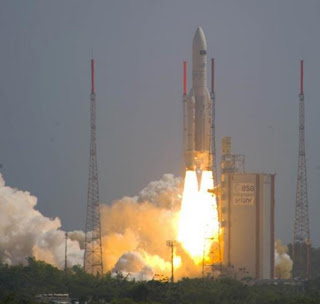
The James Webb Space Telescope will be the premier observatory of the next decade, serving thousands of astronomers worldwide after it launches in 2014. The Herschel and Planck spacecrafts, which are European Space Agency missions with significant participation from NASA, hitched a ride together on an Ariane 5 rocket May 14th this year and will begin their separate, but ambitious missions to attempt to unveil the secrets of the darkest, coldest and oldest parts of the universe.

Friday, May 15, 2009

WOW: All About Eels!

By Adele Fowler, World of Water Aquarist

Welcome back to the World of Water! Let’s head over to the Gulf Tank and answer a few questions about one of our most interesting animals: Buddy the eel! Buddy, a green moray eel, may look vicious and intimidating, but it is mostly just for show. He’s actually very tame, and loves having his back scratched!

Moray eels are remarkable animals and are not as dangerous as many people believe. In fact, in ancient times, eels were held in high regard. Julius Caesar once had six thousand morays on display at a party! Wealthy politicians used to decorate their pet eels with jewels. Their savage reputation may very likely come from one particular legend of a wealthy Roman who used to feed disobedient employees to his pet moray eels. In the present day, there have been very few instances where divers have been bitten, and in those cases, it was an accidental bite from human-initiated interaction. Morays are very shy and secretive, and would much rather flee than fight.

Another common misunderstanding is that the moray eel’s bite is poisonous. While they are not poisonous, morays can inflict a nasty bite, since their sharp teeth are covered with bacteria that may infect the wound. The only way that we could be poisoned by a moray eel is if we ate one. Eels, along with certain fish, can cause a bacterial infection known as ciguatera poisoning. Remember, Buddy doesn’t want to eat you and you don’t want to eat Buddy!

Moray eels are fish, and are found in the family Muraenidae, which is the family of “true eels.” There are 200 species in this family, and the average length of a moray eel is around five feet. The largest moray eel (the Giant Moray) can reach a length of up to 10 feet and weigh over 80 pounds! They are found in all tropical seas, and live in crevices in reefs, where they lie in wait for their prey, which consist of animals such as other fish, squid, octopuses, clams, and crustaceans. Their jaws and teeth are even specially adapted to eat these types of animals.

Moray eels have long, thin teeth, and the larger teeth are hinged to permit the smooth passage of prey into the stomach. The teeth also point backwards, so that when a moray catches its prey, it makes it more difficult for the animal to escape. They even have a SECOND set of jaws in the throat to aid in swallowing prey! These are known as pharyngeal jaws, and morays are the only type of animal that use them to actively capture and restrain prey. When feeding, morays launch these jaws into the mouth, where they are able to grab struggling prey and transport it into the throat and down to the rest of the digestive system. Eels are known as ambush predators- instead of actively searching for their prey, they lie in wait until a potential food item comes along, and then attack. Since eels can not see or hear very well, they rely mainly on their highly developed sense of smell to detect prey.

Our eel, Buddy, is almost 6 feet long and weighs about 65 pounds. We estimate him to be about 12 years old. Buddy may appear green, but believe or not, his skin is actually blue! Eels secrete a thick mucus over their skin, and the color of the mucus that is secreted over Buddy’s skin is yellow. And since yellow and blue mixed together make the color green, this is what gives Buddy his color! Buddy is nocturnal, meaning that he is most active at night, so you can normally find him napping during the day in the tank. The only time he will really come out during the day is at feeding time –he is trained to hand feed at the top of the tank. And everything that Buddy eats is carefully recorded.

If you have visited Buddy in the World of Water, something that you may have noticed is that he constantly opens and closes his mouth. While it may seem that he is being aggressive, it is actually his way of breathing! When he opens his mouth, he is actually passing water (and oxygen) over his gills. The water exits through two vent-like openings at the back of the head.

Next time you visit the World of Water, take a look at the Gulf Tank and try to spot Buddy. He is fed on Monday, Wednesday and Friday around 1:30, so come by and watch! The World of Water’s next blog, in honor of the new Shark and Ray Touch Tank, will be all about stingrays!

Contributor Profile:
Loretta and Adele's backgrounds are in the life sciences. They both love their jobs as well as all animals. Adele grew up here in Birmingham and is into yoga and gourmet cooking. Loretta grew up in Florida and just had her first child!